You downloaded a mileage tracking app. You turned on auto-detect. You assumed it was working.
But if you're like most gig drivers, your app is silently missing a huge chunk of your deductible miles—and you won't find out until tax time when your logged miles don't match reality.
The Dirty Secret of GPS Mileage Tracking
GPS-based mileage apps promise automatic tracking. Just drive, and the app figures out the rest. Sounds perfect. In practice? Not so much.
Here's what actually happens:
The app doesn't start in time. You accept a ride, start driving, and two miles later your phone finally wakes up and begins tracking. Those first miles? Gone.
Battery saver kills it. Your phone's battery optimization shuts down background apps to save power. Your mileage tracker goes dark mid-shift. You don't notice until you check hours later.
Multi-app driving breaks detection. You finish an Uber ride, switch to DoorDash, grab an Instacart batch, then back to Uber. Most apps can't tell when you're "working" across multiple platforms. Gaps everywhere.
Short trips get ignored. Quick runs—picking up a forgotten delivery bag, stopping for gas, repositioning to a busy area—often don't meet the app's minimum threshold to register as a trip.
Signal dead zones create holes. Parking garages, rural areas, downtown canyons with tall buildings. GPS loses you, and so does your mileage log.
Real Drivers, Real Missing Miles
In driver forums and Facebook groups, the complaints are constant. Drivers commonly report issues like:
- Discovering their app showed 847 miles for the month when their odometer indicated over 1,400 miles driven for work
- Noticing their tracking app wasn't running for three days straight, with no idea how many miles were lost
- Switching phones and forgetting to log back in, losing two weeks of driving data entirely
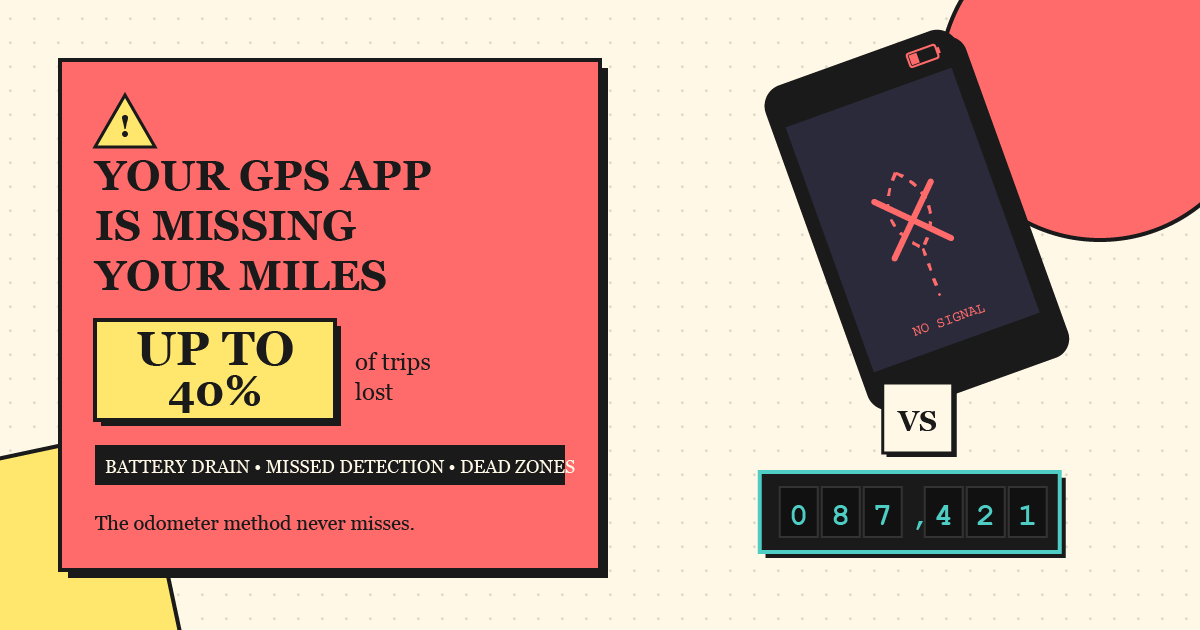
The gap isn't made up. When drivers compare their GPS app totals against actual odometer readings, the gap ranges from 20% to 50% depending on driving patterns, phone settings, and which app they use.
At $0.70 per mile (the 2025 IRS rate), missing 40% of 15,000 annual business miles means losing track of 6,000 miles—worth $4,200 in deductions you can't claim.
Why "Auto-Detect" Often Falls Short
The fundamental problem: GPS apps try to guess when you're working.
They use motion sensors, location data, and pattern recognition to decide "this looks like a work trip." But they're guessing. And guessing means missing.
When you're multi-apping between Uber, Lyft, DoorDash, and Instacart—sometimes all in the same hour—no algorithm reliably knows when your "work" started and stopped.
Some apps let you manually start and stop tracking. But then you're back to remembering to tap a button before every single trip. Miss once? Miles lost. Forget to stop? Personal miles mixed in. Now your log is unreliable, which is exactly what you were trying to avoid.
The IRS Doesn't Care About Your App's Excuses
Here's the thing: the IRS requires documentation of your business miles. If you get audited and your records show 10,000 miles but your actual driving patterns suggest you drove 16,000 for work, you have a problem.
Incomplete logs don't just mean lost deductions—they create inconsistencies that can trigger deeper scrutiny. An auditor might question your entire mileage claim if your documentation looks sloppy or incomplete.
What the IRS actually requires is simple: date, miles driven, destination, and business purpose for each trip or shift. They don't require GPS coordinates. They don't require minute-by-minute tracking. They require accurate records that you can substantiate.
The Odometer Method: What Actually Works
There's a reason the odometer method has survived real IRS audits while GPS apps leave drivers scrambling for documentation: it's impossible to miss trips.
Your odometer counts every mile. It doesn't need battery. It doesn't lose signal. It doesn't try to guess if you're working.
The process is dead simple:
- Photo of odometer before your shift
- Photo of odometer after your shift
- Quick note: date, area worked, purpose
That's it. Every mile between those two readings is captured. No gaps. No dead zones. No wondering if the app was running.
Drivers who've been audited using this method report that IRS agents find it completely acceptable—some have even commented that it's cleaner documentation than complicated GPS logs with missing segments.
The Battery Problem Nobody Talks About
GPS tracking murders your battery. The same phone you need for navigation, accepting orders, and communicating with customers is being drained by background location tracking.
Gig drivers already deal with battery anxiety. Adding continuous GPS tracking makes it worse. So what happens? You turn off location services to save battery. Now your mileage app definitely isn't tracking.
Odometer photos take three seconds and use virtually no battery. Snap, done, back to work.
What About the Trip Details?
Some drivers worry: "But the IRS wants to know where I went!"
For gig drivers, trip-by-trip logging of every pickup and dropoff isn't required—and the IRS has acknowledged this would be "burdensome recordkeeping" for independent contractors.
What you need is:
- The date
- Total miles for that work session
- General area you worked (e.g., "Downtown Chicago," "West Phoenix")
- Business purpose (e.g., "DoorDash deliveries," "Uber/Lyft rideshare")
That's the standard for gig workers. You don't need GPS breadcrumbs of every turn.
Making the Switch
If you've been relying on GPS auto-tracking, check your logs against your actual odometer. Pick a week and compare. The gap might surprise you.
Then consider whether you want to keep trusting an algorithm to guess your miles—or take 30 seconds per shift to capture them with certainty.
The math is simple: one missed shift's worth of miles per week, over a year, can cost you $500-$1,000 in lost deductions. That's real money for a problem that's entirely preventable.
Receipt.help uses the odometer photo method trusted by drivers who've passed real IRS audits. Two photos per shift. Every mile captured. No GPS battery drain, no missed trips, no guessing. $4.99/month.
This article is for educational purposes only and does not constitute tax advice. Consult a qualified tax professional for guidance specific to your situation.